Western Woods
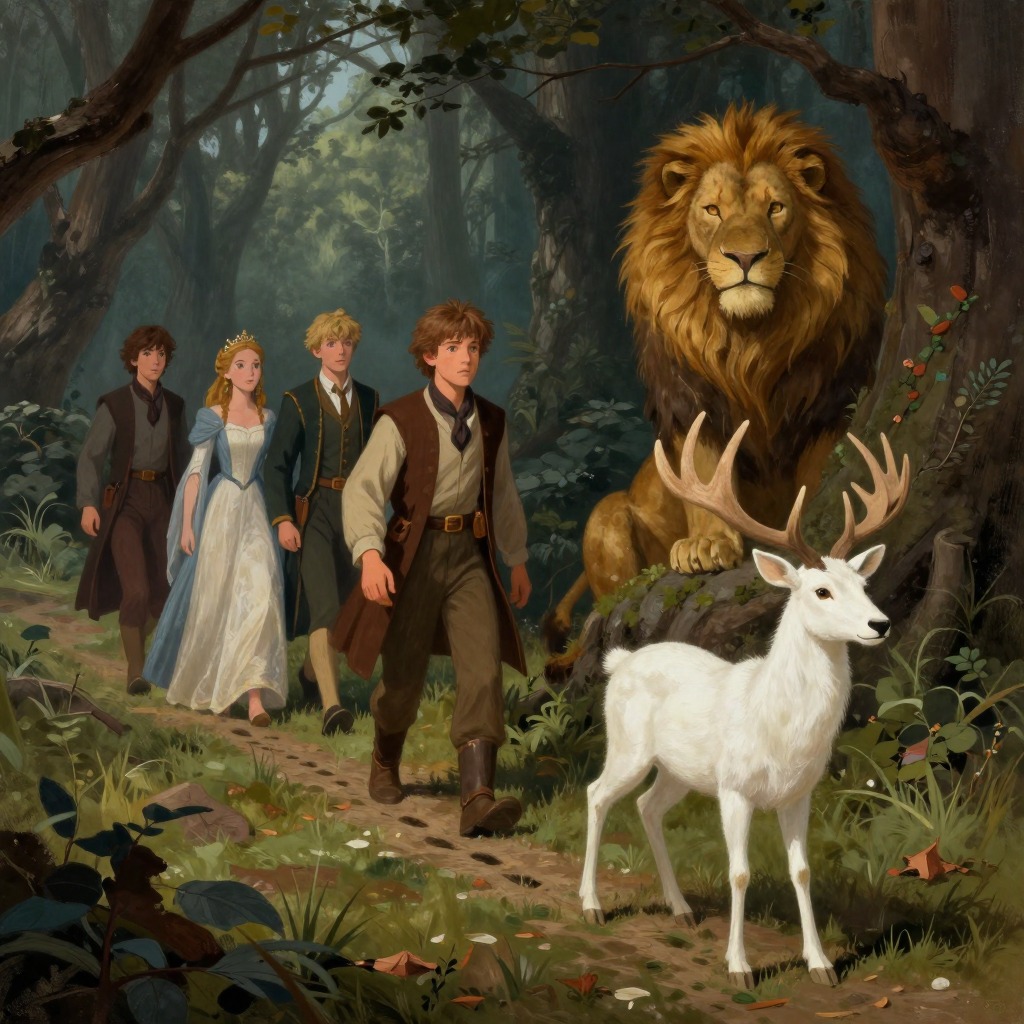
The Western Woods are the immense, primeval forest that stretches across the western reaches of Narnia, serving as the primary setting for the Pevensie children's earliest adventures and the final scene of their reign. It is a place of profound transformation, where the eternal winter of the White Witch's reign first begins to break and where the boundary between Narnia and the human world is most permeable. The woods are not merely a backdrop but an active participant in the story, a living entity whose trees can be allies or spies, and whose depths conceal both the lamp-post that marks the passage from the wardrobe and the White Stag whose pursuit leads the Kings and Queens back to their own world.
Geography and Character
The Western Woods are described as a dense, sprawling forest that lies between the lamp-post—the gateway from the human world—and the great castle of Cair Paravel on the eastern sea. The woods are characterized by their variety: there are thick fir trees where snow lies crisp and dry, open glades where the winter sun breaks through, and deep valleys with frozen rivers. The trees themselves are sentient, with some loyal to Aslan and others ready to betray travelers to the White Witch. The forest is also home to a network of hidden paths and secret places, such as the cave of the Faun Tumnus and the Beavers' dam, which serve as refuges for those opposing the Witch's rule.
The Arrival of the Children
Lucy Pevensie first enters the Western Woods through the wardrobe, stepping out into a snowy night and meeting the Faun Tumnus at the lamp-post. The woods are initially a place of wonder and danger, where the White Witch's spies lurk among the trees. When the four children enter together, they follow a robin through the forest, a guide that leads them to the Beavers. The woods are also where Edmund Pevensie, having betrayed his siblings, makes his way alone through the snow to the White Witch's castle, a journey that nearly ends in his death at the Stone Table.
The Thaw and the Spring
The Western Woods are the stage for the most dramatic transformation in the story: the melting of the White Witch's eternal winter. As Aslan draws near, the snow begins to thaw, and the forest is reborn. Streams begin to flow, flowers such as celandines, snowdrops, and crocuses appear, and birds fill the air with song. The woods become a place of lush greenery, with beeches, birches, and elms putting forth leaves, and the air filled with the scent of flowering currant and hawthorn. This change is not merely seasonal but symbolic, marking the defeat of the Witch's power and the return of life to Narnia.
The Hunt for the White Stag
Years later, after the Pevensie children have grown into the Kings and Queens of Narnia, the Western Woods are the setting for their final adventure. Tumnus, now a middle-aged Faun, brings news that the White Stag—a magical creature that grants wishes to whoever catches it—has reappeared in the woods. The four monarchs ride out with their court to hunt the Stag, and it leads them deep into the forest, past the lamp-post, and ultimately back through the wardrobe into the spare room of the Professor's house. The Western Woods thus serve as the threshold between two worlds, the place where the Narnian adventure both begins and ends.
Narrative Significance
The Western Woods function as a liminal space, a borderland between the human world and the magical realm of Narnia. They are a place of testing and transformation, where characters are forced to confront their loyalties and fears. The woods are also a repository of Narnian history and prophecy, containing the lamp-post that marks the entrance from the human world and the path to the Stone Table. Their seasonal cycle—from the dead of winter to the fullness of spring—mirrors the overarching narrative of death and resurrection that defines the story. The Western Woods are not merely a location but a living symbol of the struggle between the White Witch's tyranny and Aslan's liberating power.